Jesus Loves the Little Children

The recent 40th anniversary of Roe v. Wade, bringing with it the realization that over 50 million children have been aborted in America since 1973, has made me consider again how God views children.  Why did I tell the Children’s Ministry volunteers at our church recently that if they are involved in Family Ministry, they are involved in a ministry that is close to the heart of God?  How do you think about your own children?  Is it true that God has a soft spot of affection for little children?

I could give you verse after verse right now that affirms this truth.  Every verse about little children in the Bible is positive.  But to see what God thinks about children, we simply need to look to Jesus who is God incarnate.picture 14

I used to wonder if the paintings that we often see of Jesus holding children on his lap were true.  Does it really say that in the text?  “And they were bringing children to him that he might touch them, and the disciples rebuked them.  But when Jesus saw it, he was indignant and said to them, ‘Let the children come to me; do not hinder them, for to such belongs the kingdom of God … And he took them in his arms and blessed them, laying his hands on them.” (Mark 10:13-14, 16)

“They were bringing” has the idea of a habitual action.  This often happened in Jesus’ earthly ministry.  But how did the Lord punctuate his rebuke to the disciples?  He “took [the children] in his arms,” which could also be translated, “hugged” or “embraced” them.  When Jesus wanted to show what God thinks about children, he hugged them.  This is a picture of Jesus that we need to remember whether we’re thinking of the unborn, Family Ministry, or our own children.

Christian Parenting Reminders from Jason Helopolous

I needed to read this today and I hope that it is an encouragement in your parenting as well.  Click here for the entire excellent blog post from Jason Helopolous at the Gospel Coalition.

* * *
Some of my greatest joys in life stem from being a parent to two delightful children. However, some of my greatest struggles in life also stem from being a parent to these same two children. There are days that I cannot imagine anything more rewarding and other days that I want to get into the fetal position and remain there for a week. Here are a few reminders for me and all the other Christian parents out there:

Affection and Love: We can never show our children too much love. I have yet to meet the adult who tells me, “My parents just showed me too much love!” But sadly, I have often heard the reverse. Shower your children with affection. May they know our warm embraces and messy kisses!

Have the Right Goal in View: As Christian parents, our goal in raising our children is not primarily to prepare them for going out into the world as fully functioning adults. Our goal, as Christian parents, is to prepare our children for eternity! This should shape all that we do in our homes.

Focus on My Responsibility: But having said that, we can’t “force” our children to be faithful, less sinful, or more righteous. That isn’t our responsibility. Our responsibility is to be faithful in our own charge as parents. In that regard, I can surely hinder or help their sensitivity to Christ, growth in sanctification, understanding of grace, and maturing in character, but I can’t guarantee it, secure it, or determine it. Let’s be faithful in what we do have responsibility for and spend less energy trying to control that which we don’t have responsibility for.

Keep Your Eyes Forward: We can be prone to look over our shoulders. What will OUR parents think? What will others at church think? What will my pastor think? Our children are disobedient and we find ourselves cringing inside and looking to see if anyone else was watching. And when we see others looking on, immediate concern grips our minds. Will they think my children are disobedient or bad? Will they think I am a terrible parent? Stop! We aren’t parenting for others’ approval. We are parenting for the good of our children to the glory of God. Let’s keep our eyes looking forward and heavenward for the good of our children and the glory of God.

Don’t Get Too High nor Too Low: Children change, so let’s not get too high or too low by what we see in our child’s character, actions, or soul in any given day or during any given period. Let’s rejoice some. Let’s mourn some. But let’s do so with restraint.

Run the Right Direction: God knows a thing or two about wayward children, so let’s seek Him who has an understanding ear. What grace we need in parenting and what grace is given in Christ. May we run to Him with our frustrations, struggles, trials, and failures. He should be our first counselor and comforter.

Christianity not Morality: Morals are good, but not in and of themselves. Let’s teach our children and pray for a morality that flows from a heart changed by God’s grace. For many of us, our default is to slip into morality parenting, rather than Christian parenting. The former is focused solely upon outward behavior, the latter is focused upon inward change which will manifest fruit  in moral outward behavior.

Lastly and Most Importantly, Count the Blessings: Let’s thank God everyday for our children. Even on those hard days, find the blessings amidst the chaos! Count every blessing that comes as a parent. Let it fill us with wonder that the Lord of the Universe has given us the privilege of having these little souls under our care. What a blessing. Thinking on that may even help us get out of that fetal position.

* * *
[HT: Jason Helopolous]

Six Philosophical Pillars of a God-Honoring Children’s Ministry

picture 5

1) God’s Love for Children (Luke 18:15-17)
God has a soft spot for children as seen in Jesus’ counter-cultural attention to children.  As I have looked at every verse I can find in the Bible about children, it is clear that God speaks unequivocally positive about children.  If you are involved in Children’s Ministry, you are involved in a ministry that is close to the heart of God!

2) The Priority of Parents (Deut. 6:4-8, 11:18-20, Eph. 6:4, Ps. 78:5-7)
As I looked at every verse in the Bible I could find about children, what was even more clear than God’s love for children was the sheer quantity of verses that call parents to raise their children to know and love God.  The Bible speaks loud on this:  parents are called to be the primary disciplers in their children’s lives.  The church should support, encourage, and equip parents,  but never usurp their God-ordained role.  How that looks in each church context will be different, but if you are involved in Children’s Ministry, do you communicate with the parents in a way that recognizes them as the primary disciplers?

3) The Centrality of the Gospel (recognizing children’s spiritual potential before God; Ps. 8:1-2, Matt. 21:14-16, 2 Tim. 3:15-17)
Children’s Ministry is a ministry of evangelism!  Teaching children is probably the greatest evangelistic opportunity in any church in terms of the quantity of people within a ministry that are unsaved.  Don’t assume that all of the kids are saved, even if most of them come from Christian homes and have been coming to church for years.  Constantly press the truth of the Gospel and their need for Christ upon their hearts and minds.  For those who don’t come from Christian homes, hearing the Gospel from you may be the only time they ever do.

4) A Bible Focus (Is. 48:11, 2 Tim. 3:16)
We have an amazing opportunity in Children’s Ministry to teach children God’s Word.  I love talking to my son about Sunday School, seeing that things my wife and I have taught him are being reinforced or expanded.  I love seeing children from the community hear the Bible for the first time.

In every lesson that you teach, ask yourself if two things are present:  Is the character of God taught correctly?  Is the Gospel presented or is it tied in?  The main character of the Bible is God!  If they’re in awe of God (who God is and what He does as taught in the Bible), they will want to know Him (the Gospel).

5) Servanthood (Mark 10:42-45)
We should have a radiant attitude of servanthood in Children’s Ministry as we serve families, interacting with kids and encouraging parents.  Both children and parents will pick up on this Christ-like attitude.  In most churches, there is probably no greater chance to serve the church in the number of opportunities available than in Children’s Ministry.

6) A Kid-Appropriate Manner (1 Thess. 5:14, Phil. 2:3-8)
Jesus cared for people as individuals–He had no one system of discipleship.  God hard-wired children with imagination and a bent towards fun and energy, so if you are involved in Children’s Ministry, you must have fun!  Think of the condescension of Christ: He went from Heaven to earth; He became flesh and dwelt among us (John 1:14).  Certainly we can condescend to the children we teach by having fun with them, using our imagination with how we teach while still being ruthlessly Bible and Gospel-centered, and thinking hard about our word choices as we teach them.

Mary: An Example of a Teenager Who Loves God

picture 13We often think of Mary as a mature woman, especially when you read her “Magnificat” or “Song of Praise” in Luke 2:46-55.  However, Jewish traditions at the time of Jesus’ birth point to the fact that Mary was probably about 14 years old when she was told by the angel Gabriel that she would give birth to the Savior of the world.

In an age in which not much is expected even out of Christian teenagers, Mary is a wonderful reminder that Middle Schoolers and High Schoolers are capable of a deep relationship with God.  If you are a teenager, I pray that this will be a reminder to you to “Let no one despise you for your youth, but set the believers an example in speech, in conduct, in love, in faith, in purity.” (1 Timothy 4:12)  If you are a parent or grandparent, remember that much of Mary’s love for and knowledge of God was taught to her in the home, which was the Jewish (Deut. 6:4-9) and is the Christian (Eph. 6:4) God-ordained place of every day discipleship.

As a teenager, Mary put God’s desires for her life above her own desires (Luke 1:26-38).  Being surprised one day by the angel Gabriel and being told that she would be pregnant with the Messiah was not in Mary’s plan for her life.  This was unimaginably “inconvenient.”  Rather than complaining, Mary’s response was, “Behold, I am the servant of the Lord; let it be to me according to your word.” (Luke 1:38)  God’s will was more important to her than her will.  She not only was submissive to God’s will, she joyfully embraced being used to bring God glory (Luke 1:46-55)!  God’s will was good news to her.

As a teenager, Mary knew God’s Word and “theology” (Luke 1:46-55).  Mary’s spontaneous Song of Praise in response to giving birth to the Messiah is dripping with Scripture references and a deep understanding of God’s plan for redemptive history.  She knew and loved both Old Testament Scripture and great truths about God.  Mary’s Bible knowledge at the age of 14 reminds us that teenagers who can ace a pre-calculus class can understand and get excited about knowing God better through His living and active Word.

As a teenager, Mary knew she needed God’s grace in Christ (Luke 1:47, 1:50).  I don’t put Mary out as an example to make you simply feel bad as a teenager or as a parent.  Mary is a stunning example of a teenager who loves God, but she also knew she was a sinner who needed God to save her.  “…My spirit rejoices in God my Savior…”  The long-awaited Messiah that she now knew she would raise from infancy would show her and other believers God’s grace (Luke 1:54-55).  Mary spoke of the same grace that is offered to you today, if you will turn to Jesus and say, “I am the servant of the Lord; let it be to me according to your word.”

Give Your Teenager a Gift that Can Have an Eternal Impact

If you are the parent of a teenager or are a grandparent of a teenager, I encourage you to consider giving them one of these Bibles or books that can have an eternal impact in their life.  Just as the Apostle John had “no greater joy than to hear that my children are walking in the truth,” (3 John 4) speaking of his spiritual children, if you are a Christian parent I know that you will have no greater joy than to know that your children are walking in the truth of God’s Word.  These resources can help.  I have written a brief review of two study Bibles for teens and four carefully chosen books.

I simply ask you to consider something before you choose one of these Bibles:  think deeply about where your child or grandchild is in his or her walk with the Lord before choosing a new Bible.  Which would be the most helpful to him or her?

I have purposefully chosen books that stand alone if a teenager is motivated to read them, but that could also be easily used for parent-teenager discipleship.  Any one of these four books would be perfect for planning a time to discuss a chapter after each of you have read it.  If you have never done this, start with once a month–for example, if you chose Growing Up Christian, it has twelve chapters, so you could plan to meet with your teen the first Saturday morning of every month for one year.  Feel free to comment below if you have ever done something like this with your teenager before!

The ESV Student Study Bible is a great Study Bible for a teenager.  I love my own ESV Study Bible, and the difference between a normal Study Bible and a “Student” version is that it explains things more clearly at times for those who have not studied the Bible for as many years.  For example, at Genesis 1:26 my ESV Study Bible and the ESV Student Study Bible have essentially the same study note.  But the ESV Student Study Bible also has a graphically appealing “Did You Know?” box that explains God’s plural use of “us” in that verse.  See a video here that explains the idea behind the ESV Student Study Bible and if you’re thinking of purchasing it check out the different cover color options available.  I also recommend The MacArthur Student Bible for the same reasons as above, but it only comes in the NKJV.  If your teen is not currently reading and understanding the NKJV well, then I would stick with the ESV (if you have an older teenager, the regular MacArthur Study Bible is available in ESV and has an appealing layout with excellent study notes).

The book Growing Up Christian by Karl Graustein is the best book I have seen for teenagers who have grown up in the church.  Joshua Harris explains, “[the author] wants to see them transformed by Jesus Christ’s finished work on the cross–not merely living off the religion of their dads and moms.”  It is easy to read but has great depth and includes questions that you could use for a friendly discipleship discussion with your teen.

Don’t Waste Your Life by John Piper is a life-changing book that challenges young people to live solely for the glory of God.  He begins by writing, “The Bible says, ‘You are not your own, for you were bought with a price.  So glorify God in your body’ (1 Cor. 6:19-20).  I have written this book to help you taste those words as sweet instead of bitter or boring.”  I can’t recommend this book more for the teens and twenty-somethings in your life.  It was influential in my own call to ministry.

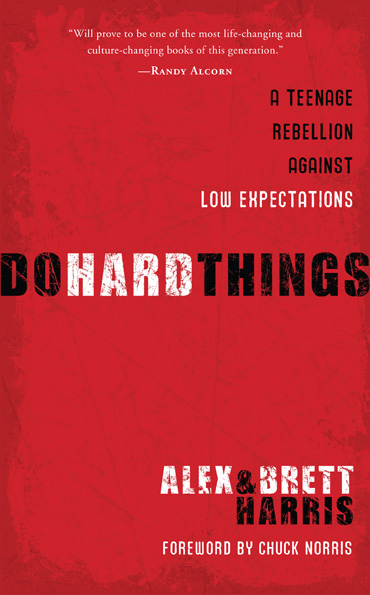
Do Hard Things by Alex & Brett Harris is subtitled, “A teenage rebellion against low expectations.”  They assault the “myth of adolescence” by challenging fellow teens to live for God now rather than later.  Here is a helpful review of this book by my friend Jesse Johnson.  This is the only book recommended here that I have not read yet myself, but it strikes me as being in the same vein as Don’t Waste Your Life but maybe better for younger teens.

Bitesize Theology: an ABC of the Christian Faith by Peter Jeffery is the perfect book for your teen if you know that what they need right now more than a challenge to live fully for Christ,  is a better understanding of the basics of God’s Word.  I have never seen another book that can explain terms like “justification” and “sanctification” in 3 easy to understand pages.  Unless you have a highly motivated teen, this would definitely be one to do together with them (there are also study questions at the end of each chapter) and it would be well worth your time!

A Gift that Really Will Last All Year: Children’s Bibles


One of the best gifts that a parent or grandparent can give a child is a good Children’s Bible.  We have found that there is no better time than Christmas to give our son a new Children’s Bible that we can read together all year.  I have given a few questions to consider before choosing one, and a brief review of four excellent Children’s Bibles.  What Children’s Bibles have been helpful to your family?

Questions to consider before choosing a Children’s Bible:

  • Does it contain enough Bible stories to read together for most of the year?  Some only have about 20 stories, but think long-term with reading this with your child every night.
  • Does it have enough pictures, and are they age-appropriate?  Children love to be read to, and you don’t want your child to dread reading their Bible with you as opposed to the other books with exciting pictures that you read together.
  • Is it biblically and theologically accurate?  Read a couple of the entire stories to get a feel for how they have explained the Bible stories.  The last thing you want to do as you read Bible stories together is teach your child incorrect facts about the Bible and God.  It is worth taking the time to look it over closely!
  • Will I commit to reading this Children’s Bible with my child regularly?  One of the most consistent ways that you can disciple your children (Eph. 6:4) is to read Bible stories with them as part of your night-time routine or other set time daily.  I am always amazed at the questions my 4 year old son asks when we read his Children’s Bible together.

The Jesus Storybook Bible by Sally Lloyd-Jones and pictures by Jago is my favorite Children’s Bible.  It ties the stories of both the Old and New Testaments into the hope of Jesus as our Savior.  We read this Bible to our son during the year that he was 3, and he loved the pictures and the way the stories are written–and so did I.  After one year of reading this, I was ready for something different that would teach him even more of the Bible, but you won’t regret getting this Bible for your child or grandchild about ages 3-10.

The One Year Bible for Children by V Gilbert Beers has been an excellent way to bring our son through some new Bible stories this year.  There really are 365 Bible stories including Psalms or Proverbs for the weekend!  My son loves the “classic” Bible story pictures.  It may have been too much for him as a 4 year old though–every other page has no pictures, so I would often google the Bible story as he would request a picture.  I would highly recommend it for ages 5-9.

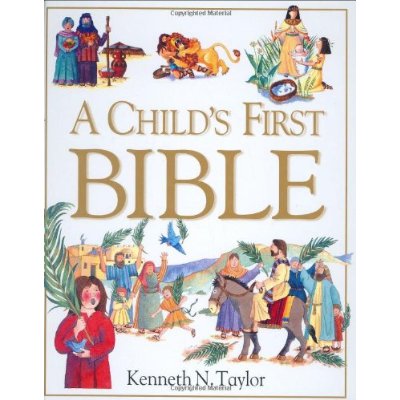
What do you read to your toddler (or younger) to begin to teach them about God and His Word?  A Child’s First Bible by Kenneth N. Taylor has been perfect.  I would recommend it for infants up to age 3.  Even our 16 month old enjoys a couple of brief stories out of this at night.  For now I paraphrase the story in a couple of sentences and point at the pictures in an excited voice as I talk about God.  She likes looking at the animals in the pictures too.  When she is closer to 2 and above we will systematically go through this whole Children’s Bible and read the text which is simple but faithful.

I am excited to begin reading The Gospel Story Bible by Marty Machowski to my son who will be 5 this year.  It has all of the elements that I listed above:  enough Bible stories to last for much of the year, a picture for each story, and biblical and theological accuracy (It has excellent reviews and I enjoyed reading several stories–it was hard to put down!).  The subtitle, “Discovering Jesus in the Old and New Testaments” reminds me of The Jesus Storybook Bible but for kids who are a touch older.  I think the sometimes abstract but colorful pictures may be too much for a child younger than age 5.

Parenting is Hard for a Reason

Christina Fox has a post at The Gospel Coalition blog that encouraged me in my own parenting this week.  I read it yesterday afternoon and then I was tried in it last night.  I love how Fox applies the gospel–as displayed in the cross–to parenting.  I need forgiveness when I see that I sinned in how I parented.  I can teach my children about the gospel and their need for forgiveness in Christ even as I ask for their forgiveness.  As Fox says, parenting is hard for a reason.  It is another reminder of our need for Christ.  Read some excerpts below or click here for the full article.

***

It had been a long and trying day where nothing went the way it should.  I must have corrected the kids every five minutes.  After refereeing fights and cleaning up messes all day, I was exhausted, irritated, and impatient.

Sitting at the dinner table that evening, it was my oldest son’s turn to give thanks.  When I heard him say, “And God, could you please help mommy to be patient with us?” I realized I wasn’t the only one affected by our difficult day.  I was part of the problem.

Before I had children, I considered myself a patient person.  Having worked with children professionally, I felt confident in my ability to interact with them.  I assumed that working with troubled children would automatically qualify me for parenting.  It was soon after I had my first child that I realized just how wrong I was.

When my kids were small, I couldn’t understand why things weren’t going as they should.  I read all the books.  I followed each method and step listed on the pages.  I did everything I was told to do.  But my children didn’t always sleep the way the experts said they would.  They didn’t potty train in a day.  I’m not convinced they’ve learned their manners.  And they didn’t (and still don’t) do what I say the first time.

I couldn’t wrap my mind around it all.  When parents seek to raise their children in a godly way, how can parenting still be so hard?  But if I believe that God is sovereign, then I must believe he is sovereign even over all the challenges I have with my children.  If they have a rough day, whine, complain, and don’t get along, it is not outside his control.

While I used to despair over my children’s imperfect sleep patterns, rambunctious behavior, and failure to say please and thank you, I now realize there is a greater purpose—my refinement. Each struggle, each exhausting day, each behavioral problem, is an opportunity for me to grow in my faith. God uses my children as mirrors to reflect to me the sin I didn’t realize resides in my heart. He is in fact using my own kids to refine and transform me.

Parenthood is tilling the soil in my heart, weeding out the sins that keep me from growing in faith. Some of the roots run deep and have entangled themselves around my heart. Before having children, I didn’t realize how deeply rooted sins like impatience, selfishness, and irritability grew in the sin-fertilized soil of my heart. It took the challenges of raising children to reveal them to me.

But even as God reveals my sins of impatience, irritability, and selfishness, he also reveals his grace. When my children are easily distracted and I respond with impatience, not only does the Spirit reveal that sin to me, he also points out to me all the ways God is patient with my own distracted heart. When struggles in parenting reveal my sin of irritability, it also shows me God’s endless forbearance. When the weeds of selfishness become apparent in my heart, I also see how selfless Christ was for me at the cross.

Time and again, the gospel of grace covers my sin, bringing me back to the cross of Christ. Jesus knew I could never be a perfect mom. He knew I couldn’t respond to my children with love and grace at every moment. He knew I’d have days where I would fail. And that’s why he came. At the cross he suffered for every time I am impatient, for every time I fail to teach and train my children, and for every time I don’t love them as he loves them.

That day when I came face to face with my sins at the dinner table, I count it as grace. For it is God’s gracious love that desires to rid me of the sins that keep me from him. And after my son prayed, I asked him for grace and forgiveness for my impatience that day. Reminding him that I am sinner just as he is, I used the opportunity to point him to the grace of Christ who bore all our sins on the cross.


HT: Christina Fox

Biblical Parenting Books

There is a plethora of resources available to Christian parents today, which is both a blessing and a problem.  How do you know which are the most biblical and which may steer you in the wrong direction?  After all, you want to be right on track with what the Bible says about parenting!  You don’t want to realize that you missed the target when your children are leaving the house, but you want to “…bring them up in the discipline and instruction of the Lord.” (Eph. 6:4)  I encourage you to make it your goal to read at least one of these books this fall!  Here are my current Top 10 Biblical Parenting Books…

Shepherding a Child’s Heart by Tedd Tripp has become a classic biblical parenting book.  If you are only going to read one parenting book this year, or if you have never read this, I can’t urge you more strongly to start with this one.  There is also an excellent Study Guide available that really expands upon the book in a simple manner, written by Tedd Tripp 10 years after the original publication, and will help you to practically work through some of the topics in your own family.

“Don’t Make Me Count to Three!” by Ginger Plowman is my wife’s favorite parenting book.  It takes the biblical principles in Shepherding a Child’s Heart and makes them extremely tangible.  My favorite quote is from the Foreword, “I’ve heard many ‘experts’ proclaim that the Bible has very little to say about raising children.  Perhaps they have spent too much time earning their degrees and too little time learning the Scriptures.  God’s Word has plenty to say to parents if we diligently read it, apply it, and reap its fruits.” (pp. 16-17)

If you are looking for a “theology” of Christian parenting, this is your book: What the Bible Says About Parenting.  John MacArthur faithfully and clearly explains the Scriptures that God has given us regarding parenting.  Don’t let “theology of Christian parenting” turn you away though–in my opinion, this is one of John MacArthur’s best books.  He is practical and passionate when he talks about the family and raising children God’s way, and it shows in his own family.

Your Family God’s Way by Wayne Mack.  If you are having communication struggles within your family, whether in your marriage, with your children, or teens, this is the book for you.  The subtitle, “Developing & Sustaining Relationships in the Home” belies that it deals with more, but the way that Wayne Mack practically explains the biblical principles of communication is worth this book’s weight in gold.

If you are struggling with being pessimistic about your family or your role as a parent, Disciplines of a Godly Family by Kent and Barbara Hughes is biblically joyful and positive.  It is chock full of ideas for enjoying your family, learning and growing together, and living for the Lord.  It is not as much of a parenting manual as some of the other books, but I highly recommend it if you need to move beyond a foundation, or if you need hope or ideas.

See my earlier blog post regarding The Duties of Parents by J.C. Ryle.  It is available in a free download as a PDF here!  It is an excellent booklet and is only 38 pages.  The only caution I give is that Ryle sees Proverbs 22:6 as an absolute promise from God rather than as a divinely inspired proverb that explains how things generally work.  If it were a promise, however, there would be no faithful parents with unfaithful children.  It is well worth reading though and it will be helpful with your parenting.

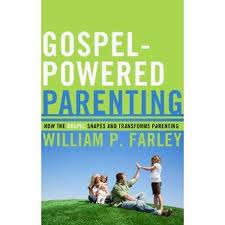
The title of Gospel-Powered Parenting: How the Gospel Shapes and Transforms Parenting by William Farley intrigued me enough to get it on my bookshelf.  I am confident commending it heartily as my Pastor, Mike Pohlman, recommends it.  See his blog post here.  Farley says in his Introduction, “In my experience, the most effective parents have a clear grasp of the cross and its implications for daily life.”

The Faithful Parent: A Biblical Guide to Raising a Family by Martha Peace and Stuart Scott is written by the same author  that I have trusted enough (Scott) to read The Exemplary Husband three times!  In an interview about this book Scott remarked that it is written from a “different yet biblical perspective: God’s and the parent’s faithfulness rather than the ‘product’ or the outcome.”

In Age of Opportunity: A Biblical Guide to Parenting Teens, Paul David Tripp hopefully titles the first chapter, “Age of Opportunity or Season for Survival?”  Certainly it is the former.  Ken Sande explains that this book “…provides a superb road map for raising teenage children…[and] experiencing with them the challenges, victories, and joys of our journey to maturity in Christ.”

Growing Up Christian by Karl Graustein is not a parenting book.  It is actually written to teens who have grown up in the church and subtitled, “Have you taken ownership of your relationship with God?”  It is well written and a book that would be perfect for a parent of a teenager to read simultaneously with their teen and discuss over coffee or a meal together.  It would be a great way to shepherd your child’s [teen’s] heart!

The Blessing of Being a Parent

image

Behold, children are a heritage from the Lord, the fruit of the womb a reward. Like arrows in the hand of a warrior are the children of one’s youth. Blessed is the man who fills his quiver with them!” Psalm 127:3-5a.

Note: Our 3rd blessing, Ezra Counts (see picture above), was born yesterday!

As congratulations have come pouring in on the birth of our son, one word I have often enjoyed hearing is “blessing.” If one word could be used to describe God’s attitude toward children, it is “blessing.” Think of the attitude of the psalmnist in Psalm 127. Heritage. Fruit. Reward. Blessing.

Contrast this with the often heard world’s view of children: Expensive. Brats. Time-consuming. Unwanted.

We need to have our minds renewed by God’s Word in every area of life. The tricky part usually comes years later. It’s pretty normal to be joyful when a new baby is born. But Moms, don’t forget God’s blessing on you when that child is having terrible two tantrums. Dads, don’t forget God’s blessing on you when you have to talk to your teen about dating or driving privileges. It’s a blessing from our good and gracious God to be given children. They are a stewardship from Him. May we take up that stewardship joyfully for the next eighteen plus years.

“The Duties of Parents” by J.C. Ryle and Free Download

All Christian parents need biblical, helpful reminders of what their responsibilities are to their children.  I have been so encouraged and challenged by The Duties of Parents by J.C. Ryle that I am quoting Ryle’s first 3 points below.  If I hear they are helpful, I may quote more portions in the future.  Here’s the great news: the entire 38 page booklet is available in a free PDF or Kindle dowload here (if you would rather have the published booklet for less than $5, click here).

1) First, then, if you would train your children rightly, train them in the way they should go, and not in the way that they would.

Remember children are born with a decided bias towards evil, and therefore if you let them choose for themselves, they are certain to choose wrong.

The mother cannot tell what her tender infant may grow up to be–tall or short, weak or strong, wise or foolish: he may be any of these things or not–it is all uncertain.  But one thing the mother can say with certainty: he will have a corrupt and sinful heart.  It is natural to us to do wrong.  “Foolishness,” says Solomon, “is bound in the heart of a child” (Prov. 22:15).  “A child left to himself bringeth his mother to shame” (Prov. 24:15).  Our hearts are like the earth on which we tread; let it alone, and it is sure to bear weeds…

If you cannot make up your mind to this first principle of Christian training, it is useless for you to read any further.  Self-will is almost the first thing that appears in a child’s mind; and it must be your first step to resist it.

2) Train up your child with all tenderness, affection, and patience.

I do not mean that you are to spoil him, but I do mean that you should let him see that you love him.

Love should be the silver thread that runs through all your conduct.  Kindness, gentleness, long-suffering, forbearance, patience, sympathy, a willingness to enter into childish troubles, a readiness to take part in childish joys–these are the cords by which a child may be led most easily–these are the clues you must follow if you would find the way to his heart.

Few are to be found, even among grown-up people, who are not more easy to draw than to drive.  There is that in all our minds which rises in arms against compulsion; we set up our backs and stiffen our necks at the very idea of a forced obedience.  We are like young horses in the hand of a breaker: handle them kindly, and make much of them, and by and by you may guide them with thread; use them roughly and violently, and it will be many a month before you get the mastery of them at all…

3)  Train your children with an abiding persuasion on your mind that much depends on you.

…this is one of God’s merciful arrangements.  He gives your children a mind that will receive impressions like moist clay.  He gives them a disposition at the starting-point of life to believe what you tell them, and to take for granted what you advise them, and to trust your word rather than a stranger’s.  He gives you, in short, a golden opportunity of doing them good…

Beware of that miserable delusion into which some have fallen–that parents can do nothing for their children, that you must leave them alone, wait for grace, and sit still.  These persons have wishes for their children in Balaam’s fashion–they would like them to die the death of the righteous man, but they do nothing to make them live his life.  They desire much, and have nothing.  And the devil rejoices to see such reasoning, just as he always does over anything which seems to excuse indolence, or to encourage neglect of means.

I know that you cannot convert your child.  I know well that they who are born again are born, not of the will of man, but of God.  But I know also that God says expressly, “Train up a child in the way he should go,” and that he never laid a command on man which He would not give man grace to perform.  And I know, too, that our duty is not to stand still and dispute, but to go forward and obey.  It is just in the going forward that God will meet us.  The path of obedience is the way in which He gives the blessing…